

1. Decide what the day is for
The first decision is the purpose, because it sets the field size, the format and the money. Most tournaments are one of five kinds.
- Fundraiser. The field is as big as the course allows, the format is a scramble so anyone can enter, and sponsors, contests and an auction matter as much as the golf.
- Corporate day. Clients or staff, 40 to 80 players, the host pays most of the cost, and success is whether the guests enjoyed it.
- Society day. Friends or colleagues who play a few times a year. The entry fee covers the golf and a meal, the format is usually Stableford, and the prizes come from the entry money.
- Club open. Members and visitors, played off handicap in stroke play or Stableford under the club’s own rules.
- Memorial. Often a fundraiser too. Ask the family what they want before anything is booked.
Write the purpose down in one sentence with a target: a sum to raise, a number of guests, or a good day for 40 members. Test every later decision against it.
2. Set the budget and the entry fee
The decision is the entry fee, and you cannot set it until you know the costs. List everything you will pay for, divide by the number of players you can count on, not the number you hope for, and add the margin you want to raise. Here is our worked example for a 100-player charity scramble. UK and Irish organisers can read the same round figures as pounds or euros; the arithmetic does not change.
| Cost | Basis | Total |
|---|---|---|
| Green fees and carts | 100 players at $60 | $6,000 |
| Food and drink | 100 players at $35 | $3,500 |
| Prizes | Team prizes and contests | $1,200 |
| Signage and printing | 18 tee signs, banner, start sheets | $400 |
| Insurance | Hole-in-one cover for one par 3 | $350 |
| Software | Registration, payments, scoring and leaderboard | $50 |
| Contingency | About 5 percent of the above | $600 |
| Total | $12,100 |
Divide $12,100 by 100 players and the break-even entry fee is $121. A fee of $150 leaves $29 a head, or $2,900, before a single sponsor signs. If only 80 players turn up, break-even rises to about $151 and the margin is gone, which is why you divide by a cautious count. Negotiate the green fee and the meal; together they are three quarters of the bill.
The software line is Parful’s price for that example, a one-day scramble with sponsors, donations and an auction. A one-day tournament in a free format is free; the current add-on prices are on Parful’s pricing page.
3. Pick the date and the course

The decision is a date and a venue that can take your field. Courses book their best weekend dates a year ahead, so for a large day start 9 to 12 months out, and for a club or society day about 6 months out. Weekdays are cheaper and easier to book.
Take these questions to the course and write the answers into the contract.
- Is a shotgun start allowed, and for how many groups? Some courses cap it at 18, some at 36, some will not close the course at all.
- How many carts are there, and what happens if the field needs more?
- What are the food and bar minimum spends?
- What deposit is needed, when is the balance due, and what are the cancellation terms?
- Who decides the course is unplayable, and is there a rain date or a refund?
- How far out do they want final numbers, and can they move by a few either way?
Go in knowing your group count. Enter your expected field into the free planner and it tells you how many groups you need and whether a shotgun can take them.
4. Choose the format

The decision is the format, and it should follow the players: clients who play twice a year want a scramble, club members want Stableford or stroke play.
Scramble. Every player tees off, the team picks its favourite ball, and all play from there until the ball is holed. It suits fundraisers and corporate days because a weak player costs the team nothing. No handicaps are needed, though many days apply a team allowance. Allow 4 hours 15 to 4 hours 45.
Texas and Florida scramble. Two variants for groups who find a plain scramble too easy. In a Texas scramble each player’s tee shot must be used a set number of times, often three; in a Florida scramble the player whose ball is chosen sits out the next shot. Allow 15 minutes more than a scramble.
Stroke play. Each player counts every shot, and the lowest total wins, gross or net of handicap. It suits club opens and serious golfers, needs a handicap for every player if there is a net prize, and one bad hole can ruin a round. Allow 4 hours 30 or more.
Stableford. Points on each hole against par after handicap strokes: one for a bogey, two for par, three for a birdie, and a bad hole can be picked up without wrecking the round. It is the format most UK and Irish society and club days are built on, because it keeps the pace up and keeps every player in it to the end. It needs each player’s handicap and the course’s stroke index, since the points depend on both. Allow about 4 hours 15.
Best ball. Everyone plays their own ball and the lowest score in the pair or four counts on each hole. It suits club days where people want their own game but a team result. It needs handicaps for a net version and takes as long as stroke play.
Skins. Each hole is worth a skin, won outright by the lowest score and carried over when tied. It suits small fields and side games, and needs a decision on gross or net and a last-hole rule.
Match play. Holes won and lost against one opponent or pair, in a knockout or round robin. It suits club competitions over several weeks, because a bracket of 64 needs six rounds. It needs handicaps and a draw; a round takes about 4 hours.
5. Size the field and build the groups
The decision is how many players you take, and the course sets the ceiling. Golf is played in fours, so a field of 72 is 18 groups, one per hole. That is the standard shotgun: everyone tees off together at a horn and everyone finishes within half an hour of each other.
Above 18 groups the course has to start two groups on some holes, an A and B start. A field of 100 is 25 groups, so 7 holes carry two groups, and the day runs 20 to 30 minutes longer. Above 36 groups, or 144 players, a single shotgun is full and the course will offer two waves or tee times instead.
A tee-time start sends one group off every 8 to 10 minutes, with the tenth tee doubling the rate if the course allows. With 18 groups at 10-minute intervals from 9:00, the last group starts at 11:50 and finishes around 4:30, a long wait for the meal.
When the field does not divide by four, spread the players as evenly as you can without going over the group size: 30 players make 8 groups, six of four and two of three. Never make a five. The planner does this arithmetic for any field from 2 to 400 and shows the shotgun plan or the tee-time window. Set a maximum field before registration opens and hold a waiting list once you reach it.
6. Open registration and take payment
The decision is how players enter and pay, and the answer is online. A paper form and a cheque means one person chasing 100 people; online entry means the field builds itself and the money is in before the day.
Collect only what you will use, and collect it at entry.
- Name, email and phone, so the player can be reached if the day changes.
- Handicap, if the format needs one. Ask for the index and the club.
- Team or partner requests, built into fours by the deadline.
- Dietary needs, and shirt size if there is a gift.
Set three dates: entries open, an early-bird deadline a month or two out, and a final deadline about two weeks out so the course can have its numbers. Publish a refund rule and stick to it; ours is a full refund up to the final deadline and none after it unless the place is resold.
Where the entry fee is paid by card through Parful, the player pays the card and service fees on their entry, and the organiser receives the fee they set. Say so on the entry page.
7. Find sponsors

The decision is what you will sell and for how much. Sponsorship is where a fundraiser makes most of its money, and it is sold months ahead, so start as soon as the course is booked. The usual items are the holes, the contests, the meal, the drinks cart, the prizes and the title of the day.
Here is one three-tier structure as an example. It is not a market rate; price yours to your sponsors.
| Tier | Price | What the sponsor gets |
|---|---|---|
| Title sponsor, one | $2,500 | Name on the tournament, banner at the first tee, logo on the entry page and leaderboard, a team of four, a word at the prizes |
| Contest or meal sponsor, four to six | $750 | Name on the contest or meal, a sign where it happens, a mention at the prizes |
| Hole sponsor, up to eighteen | $250 | A sign on the tee and the name on the clubhouse TV board |
Sold out, that structure adds about $10,000 to the example budget above. Write a one-page sponsor pack and send it with a phone call. Then deliver what you sold: check every tee sign is on the right hole before the horn, put the names on the leaderboard and the TV board, read them out at the prizes and send a photo of the sign with the thank-you.
8. Add contests and fundraising games
The decision is which games to run, and the rule is a few run well rather than many run badly. Each needs a marker, a sign and someone to collect the result.
- Nearest the pin. On a par 3, a marker moves to each closest tee shot on the green. Simple and popular; sponsor it.
- Longest drive. On a wide par 5, for the longest drive in the fairway. Run one for men and one for women.
- Straightest drive. A rope down the middle of a fairway; closest to it wins. Fairer for mixed abilities.
- Putting contest. On the practice green before the start, a dollar or two a go.
- Mulligans. A second shot, sold at registration at $5 to $10 each, limited to two a player. Announce them in the briefing.
- String. Each team buys a length of string and can move the ball that distance, cutting off what they use.
- Beat the pro. The club pro stands on a par 3 and players pay to get closer than the pro.
- Hole-in-one. A car or a large cash prize on a par 3. This one needs insurance, bought in advance on the insurer’s yardage and witness rules. Do not offer a prize you have not insured.
Raffles, lotteries and 50/50 draws are regulated differently in each country and often need a permit or a registered charity behind them. Check your local rules before you sell a ticket, and if the day is for a charity, check with the charity, because the licence is often theirs. This guide is not legal advice.
9. Prizes
The decision is how far down the field the prizes go, and the rule of thumb is that a winner should feel the prize beat the entry fee. A $150 entry and a $40 voucher for first place sends people home flat. For a 100-player scramble, our prize table is first, second and third team, two or three contests, and a fun award such as the highest team score.
Give gross and net prizes where handicaps are in play, so the low handicappers win the gross and everyone else has a chance at the net. Avoid structures that reward only the lowest handicaps; a field that knows it cannot win will not come back. Pro shop or sponsor vouchers are easier than trophies to source and to enjoy.
Publish the tie rule with the prizes. The usual one is countback: the better score over the back nine, then the last six holes, then the last three, then the last hole. Print it on the start sheet so the committee is not inventing it in the car park.
10. Food, drink and the evening
The decision is how much of the day is golf and how much is the clubhouse. The usual shape is a breakfast roll at check-in, a halfway house or drinks cart on the course, and a meal with the prizes afterwards.
- Breakfast rolls and coffee from the moment check-in opens; players arrive hungry and early.
- A halfway house, or a drinks cart that does two laps, with a sponsor paying for the first drink.
- A meal within 45 minutes of the last card coming in, while everyone is still there.
- A bar tab or drinks vouchers rather than an open bar, the fastest way to lose a budget.
- Speeches kept to ten minutes in total: a thank-you, a word from the title sponsor, the cause in two minutes.
- The auction, if there is one, after the main course and before the prizes, with eight to ten lots at most.
Run the prizes before the room thins out, and finish with the big one.
11. Volunteers and the committee
The decision is who does what. A committee of three to five carries the planning: one leads, one owns the money, one owns sponsors, one owns the course and the food. On the day, these roles need bodies.
- Registration. Two at the check-in table with the start sheet, selling mulligans and handing out cart cards.
- Starters. One at the first tee for a tee-time start, or two on the course to get a shotgun away cleanly.
- Contest marshals. One on each contest hole, with a sign-in sheet.
- Scoring help. One taking cards and watching the leaderboard, one phoning any group that has not entered a score.
- Photos. One visiting every tee, so every team and sponsor sign is photographed.
- Sponsor host. One whose only job is the title sponsor and the guests who do not play.
Our own estimate of how many you need on the day.
| Field | Groups | Volunteers | Where they go |
|---|---|---|---|
| 72 players | 18 | 6 | 2 registration, 1 starter, 2 marshals, 1 scoring |
| 100 players | 25 | 8 | 2 registration, 2 starters, 2 marshals, 1 scoring, 1 photos |
| 144 players | 36 | 11 | 3 registration, 2 starters, 3 marshals, 2 scoring, 1 sponsor host |
Brief volunteers the week before, give each a printed sheet with their role, their hole and the organiser’s phone number, and feed them.
12. Tournament day run sheet
The decision is the timing, written down and handed to the course, the committee and every volunteer. This is our run sheet for a 72-player shotgun scramble starting at 9:00.
| Time | What happens | Who |
|---|---|---|
| 7:00 | Volunteers arrive, tee signs and contest markers out, registration table set | Committee |
| 7:30 | Check-in opens, breakfast rolls out, mulligans and putting contest on sale | Registration |
| 8:30 | Briefing at the first tee: format, rules, contests, scoring, pace of play, finishing time. Carts leave at 8:40 | Organiser |
| 9:00 | Shotgun start on the horn | Course |
| 10:30 | First pace-of-play check, every group 6 holes in | Starters |
| 12:00 | Second check, kitchen told the expected finish | Starters |
| 13:30 | First groups finish, scores confirmed, cards handed in | Scoring |
| 14:00 | Last group in, contest sheets collected, results checked | Scoring |
| 14:15 | Results final, countback applied, leaderboard on the clubhouse TV | Organiser |
| 14:30 | Meal served | Course |
| 15:15 | Speeches, auction if there is one, then prizes from the contests up to the winning team | Organiser |
| 16:00 | Close, signs collected, takings counted and locked away | Committee |
13. Scoring and results
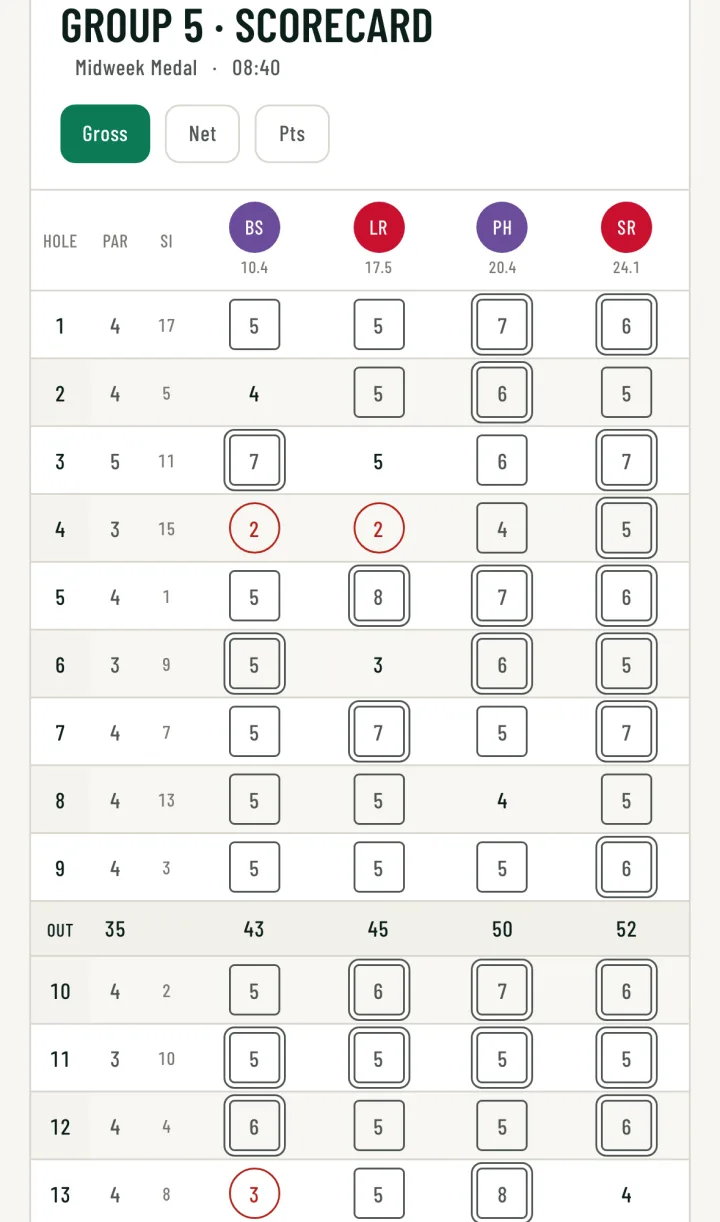
The decision is how scores get from the course to the prize table, and the aim is results that are final before the meal is cleared. The old way is a paper card per group and two people adding columns for 40 minutes. The simpler way is one phone per group, with the scorer entering each hole as the group walks off the green and the leaderboard updating in the clubhouse.
In Parful, scoring is one phone per group in the browser, nothing to download, and the scorer needs no account; they open the link the organiser sends and pick their group. Keep a paper card in the bag as the backup and the record for any dispute, and put the scoring link on the start sheet and the cart card.
Settle ties by countback as published with the prizes. Settle disputes before the prizes, not during them: the committee looks at the paper card, hears both sides and decides. Check every contest sheet is in before results are declared.
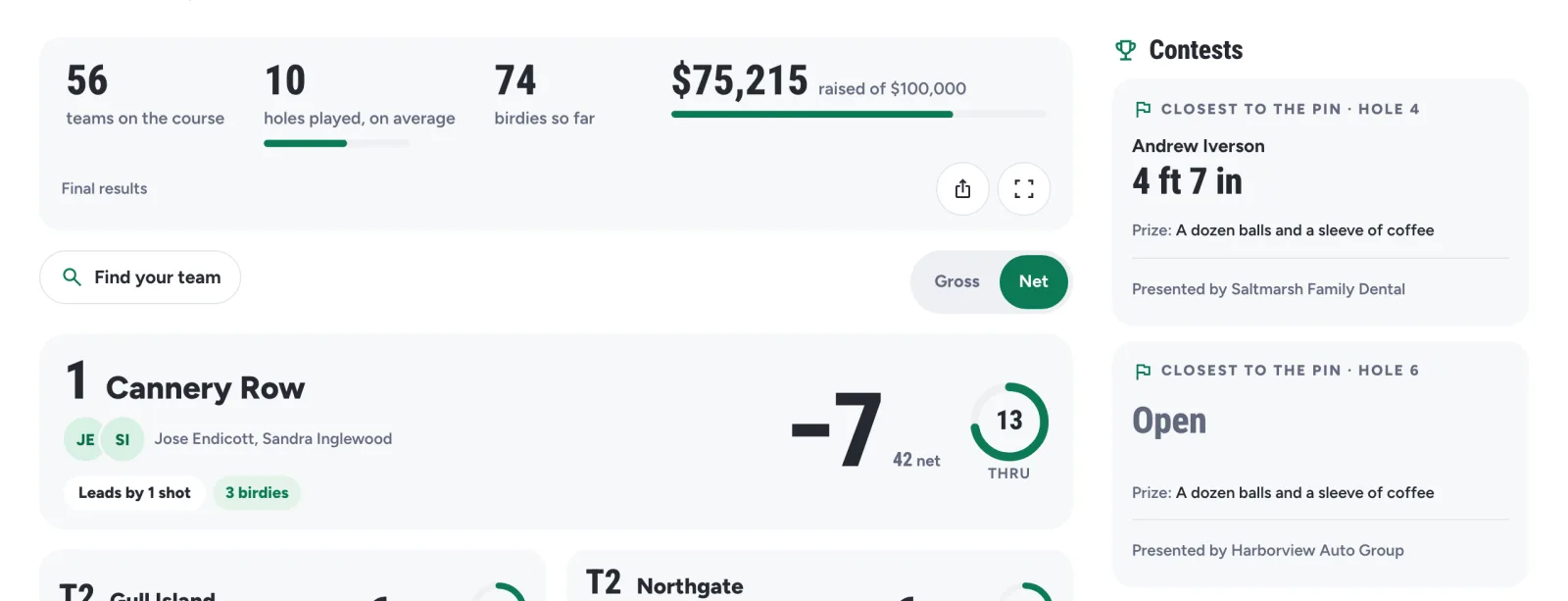
Once the last card is in, show the leaderboard on the clubhouse TV while people eat. If you want to run registration, payments and scoring this way, create your tournament in ParfulOpens Parful.
14. After the day
The decision is what you do in the week after, and it decides whether next year is easy.
- Within two days, email every player and sponsor with a thank-you, the results and the total raised.
- Within a week, send the photos, sorted by team and sponsor sign.
- Within two weeks, close the accounts and write the net figure against the target you set at the start.
- Within a month, hold a 30-minute committee review: what worked, what did not, what changes next year.
- Hold the date with the course for next year while everyone remembers the day.
Keep the entry list, the sponsor list, the budget and the run sheet in one folder for next year.
15. Timeline
The decision is when to start, and our answer is 6 months out for a club or society day and 9 to 12 months out for a large charity or corporate day, because a big day needs a prime date booked a year ahead and sponsor money that takes months to close.
| Months out | Large charity or corporate day | Club or society day |
|---|---|---|
| 12 | Agree the purpose and the target, form the committee, book the date and the course | |
| 9 | Set the draft budget, write the sponsor pack, open the title sponsor conversation | |
| 6 | Open registration, approach hole and contest sponsors, book hole-in-one insurance | Book the date and the course, set the budget and the entry fee, pick the format |
| 5 | Title sponsor signed, entry page live with sponsor logos | Open registration |
| 4 | Contests decided, prizes sourced, menu agreed | Menu agreed, prizes sourced |
| 3 | Auction lots sought, volunteers asked, signage to the printer | Chase entries, settle the tie rule and prizes |
| 2 | Early-bird deadline, sponsor list closed, second push on entries | Early-bird deadline |
| 1 | Final deadline, numbers to the course, start sheet built, run sheet to everyone | Final deadline, numbers to the course, start sheet built |
| Week of | Volunteers briefed, scoring link tested, signs and prizes collected | Start sheet sent, scoring link tested |
| Week after | Thank-yous, results, photos, accounts closed, date held | Thank-yous, results, date held |
16. Mistakes that sink a tournament
- Setting the entry fee before costing the day. Build the budget first and divide by a cautious count.
- Booking a course that cannot take the field in one shotgun. Ask the limit before you sign.
- Choosing stroke play for occasional golfers. Pick a scramble or Stableford so nobody cards a 12 and gives up.
- Letting registration run on paper and promises. Take entries and money online with a deadline.
- Leaving sponsors until the last month. Start selling the week the course is booked.
- Offering a hole-in-one prize without insurance. Buy the cover in advance or do not offer the prize.
- Running six contests with nobody marshalling them. Run two or three, each with a person, a sign and a sheet.
- Starting the prizes two hours after the last group finishes. Score on phones so results are final when the meal is served.
- Giving every prize to the lowest handicaps. Split gross and net and add prizes the back of the field can win.
- Finishing with no thank-yous and no date for next year. Send the results within days and hold the date.
17. Questions organisers ask
How many players do I need for a shotgun start?
A full single shotgun on 18 holes is 72 players in 18 groups of four. Fewer is fine, with some holes left empty; more means doubled holes up to 144 players, if the course allows it.
How long does a golf tournament take?
Allow about 4 hours 30 for 18 holes after the last group starts, then an hour and a half for the meal and the prizes. A 9:00 shotgun day finishes around 4:00.
Do players need to download an app to score?
Not with Parful. Scoring runs in the phone’s browser from a link, one phone per group, and the scorer needs no account.
Do players need an account to register?
To register and pay online through Parful, yes, so the entry and receipt are theirs. To score on the day, no.
What does the software cost for a one-day tournament?
A one-day tournament in a free format is free in Parful. Add-ons such as sponsors, donations or an auction cost extra, players pay card fees on their entries, and nothing is charged until the tournament goes live.
Which formats are free in Parful?
Stroke play, scramble, Stableford, skins, Florida scramble and Texas scramble. Other team formats, such as best ball, and match play are paid add-ons.
Can the free planner create my tournament?
No. The planner works out groups, the shotgun plan or tee-time window and your checklists, and it sends nothing anywhere. Parful creates and runs the tournament.
Does Parful work outside the US?
Yes. It is built for organisers in the UK, Ireland and the US. Scoring and the leaderboard run in the browser, so they work anywhere your players have a phone and a signal.
That is the whole job, in order. Plan the field with the free planner, take the group count to the course, and when you are ready to open entries, create the tournament in ParfulOpens Parful.